
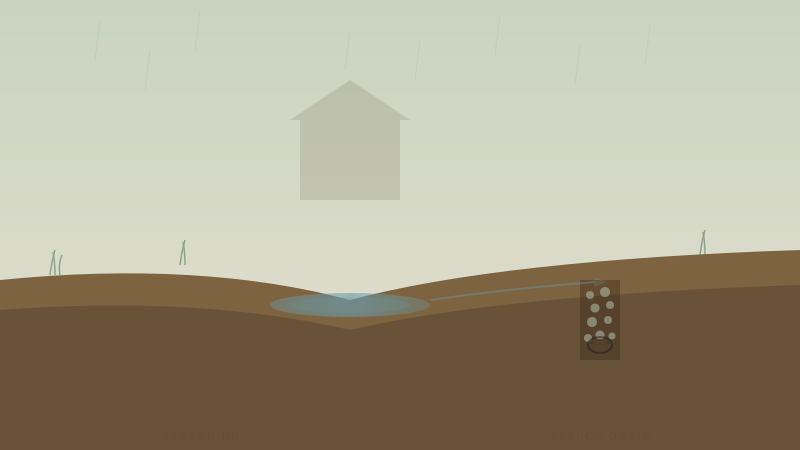
French Drain vs. Regrading: Which Fixes Your Drainage Problem?
If you’ve got standing water in your yard after it rains, you’ve probably already Googled “French drain” or “yard drainage solutions.” Both French drains and regrading solve water problems — but they solve different kinds of problems. Here’s how to tell which one you need.
When Regrading Is the Right Fix
Regrading means reshaping the surface of your yard so water flows away from where it’s pooling. It’s the simplest solution, and sometimes it’s all you need.
Regrading works when:
- Water pools against your foundation because the ground slopes toward your house
- You have low spots in your yard that collect water
- The grading was done poorly during construction (common in newer Columbia neighborhoods)
- The drainage issue is at the surface level
Regrading is less invasive and typically less expensive than installing a French drain. If water can be redirected by simply reshaping the ground, that’s usually the best approach.
When You Need a French Drain
A French drain is a sub-surface system — a trench filled with gravel and a perforated pipe that captures water underground and redirects it to a safe discharge point.
French drains work when:
- The water table is high and the ground stays saturated
- Surface regrading alone can’t solve the problem
- Water seeps into your basement or crawl space
- You need to intercept water flowing from an uphill neighbor’s property
- Your soil is heavy clay that doesn’t drain well (very common in Boone County)
French drains handle subsurface water that regrading can’t address.
Can You Need Both?
Yes — and that’s actually pretty common in Columbia. I often regrade the surface to direct water away from the house, then install a French drain to handle the underground water that regrading can’t fix.
What About Downspout Extensions?
Before doing any major drainage work, I always check your downspouts. It’s surprising how often “yard drainage problems” are actually just roof water dumping right next to the foundation. Extending downspouts 6-10 feet away from the house can solve a lot of issues on its own.
How to Tell What You Need
Honestly, the best way to figure out your specific situation is to have someone look at it. During a free consultation, I’ll walk your property after a rain (or simulate one), identify where water is coming from and where it’s going, and recommend the simplest effective solution.
Not the most expensive solution. The simplest one that actually works.
The Cost of Doing Nothing
Drainage problems don’t fix themselves — they get worse. Standing water kills grass, damages plants, attracts mosquitoes, and can cause serious foundation issues over time. The longer you wait, the more expensive the fix.
If you’re dealing with water issues in your Columbia yard, let’s talk about it. I’ll give you an honest assessment and a clear path forward.

Tony Yuhas
Owner of Terraformed Homes. I do the design, the install, and everything in between — personally, on every project in Columbia, MO.
About Tony